

Swiss Rail Adventure
Switzerland by Rail: Where the Journey Is Part of the Experience
Sean’s Swiss Adventure: Exploring Switzerland by Rail

Share:


There are some countries that simply make sense by rail, and Switzerland has to be one of the finest examples.
Travelling across the country with my partner, Adam, gave us a front-row seat to landscapes that seemed to change by the hour. One moment we were travelling alongside Lake Geneva, with vineyards climbing the hills above us; the next we were winding through Alpine valleys, passing waterfalls, traditional villages and mountains that seemed to grow larger with every mile.
That is perhaps the greatest pleasure of travelling through Switzerland by train. The railway doesn’t simply connect the places you have come to visit. It runs straight through the scenery you have come to see.
Over seven days, we travelled from the UK to Geneva via Paris, before crossing Switzerland on a mixture of its everyday rail network and some of its most celebrated trains: the Belle Époque, GoldenPass Express and Glacier Express. We stayed beside Lake Geneva, climbed to Glacier 3000, spent two nights high in the Alps in Mürren, travelled east to Chur and finished in Zurich, with the Rhine Falls and Stein am Rhein still to come.
There were some big moments along the way, but what I loved most was the sense that the journey never really stopped. There was rarely a point when we were simply travelling to the next place.
Switzerland was happening outside the window the entire time.
Starting the journey before reaching Switzerland
Our journey began in London, travelling in Eurostar Plus to Paris before continuing by train towards Geneva.
There is something I’ve always enjoyed about beginning a European journey by rail. You don’t suddenly arrive in another country several hours later; you watch the journey happen around you.
London becomes Paris, Paris gradually disappears and the landscape changes again as you travel towards Switzerland. There’s time to talk, read, have something to eat, watch the world outside and settle into the rhythm of travelling.
And that rhythm became an important part of the week ahead.
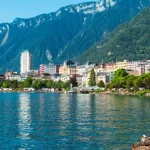
Geneva was our first base for two nights. Elegant and international, but with the lake and mountains never far from view, it provided a gentle introduction to Switzerland before we began travelling further into the country.
If you have time here, it is worth doing more than simply walking around the centre. Spend time beside Lake Geneva, explore the Old Town and leave enough space in the itinerary to get out into the surrounding region.
For us, that meant wine.
Wine overlooking Lake Geneva
One of our first experiences was a visit to Lavaux Vinorama, surrounded by the vineyard terraces of Lavaux.
This is one of those parts of Switzerland where the landscape and the experience are difficult to separate.
Vineyards cover the slopes above Lake Geneva, creating lines of green that tumble towards the water. Beyond them sits the enormous expanse of the lake, framed in places by mountains on the opposite shore.
At Vinorama, we had the opportunity to learn about and taste wines grown locally in the region. Swiss wine isn’t something we see huge amounts of at home, and being able to drink it in the landscape that produced it made the experience feel much more connected to the place.
It is exactly the sort of excursion I would recommend building into a rail itinerary. Switzerland’s trains make it tempting to keep moving, but some of the best moments come from getting off them.
Give yourself time in Lavaux. Walk among the vineyards if the weather allows, stop for a glass of local wine and take in the views across the lake. It is somewhere that rewards a slower pace.
That slower pace would follow us throughout the week.
The Belle Époque: when the train deserves some attention too
The scenery became steadily more dramatic as we continued our journey, but so did the trains.
Travelling aboard the Belle Époque is an experience in itself. Its elegant interiors deliberately evoke the golden age of rail travel, with a style very different from the modern trains we would use elsewhere during the week.
It would be easy to think of a train like this as a novelty, but that undersells it.
The real pleasure is the combination of the carriage and the landscape outside it. Settle into your seat, resist the temptation to spend the entire journey taking photographs and actually look out of the window.
That sounds obvious. In reality, when the scenery becomes this good, your phone can quickly become a permanent extension of your hand.
My advice? Take the photographs. Take far too many, if you’re anything like us. But then put the phone down for a while.
Some views are better remembered as moments rather than camera rolls.

A few things worth knowing about Switzerland’s panoramic trains
If you are new to rail travel in Switzerland, one of the first questions is usually whether you need to reserve a seat.
For most ordinary Swiss trains, the experience is remarkably straightforward: check your journey, arrive at the station and board. Some of the panoramic trains work differently, with reservations required or recommended depending on the service.
Travelling with Marvellous Escapes meant all of those details had already been considered as part of our itinerary, so we could simply enjoy the journey. And, having experienced the routes for ourselves, it reinforced just how valuable that can be. Switzerland is incredibly easy to travel around, but knowing which trains need reservations, where connections work best and how to bring the different scenic routes together can make a good itinerary feel effortless.
Another question is inevitably: which side should I sit on?
I wouldn’t become too obsessed with it.
The landscape changes constantly and, particularly on longer journeys, there are impressive views from both sides. Trains can also change direction. If you are travelling together, sitting opposite one another can work well because between you, you effectively have a view in both directions.
And travel light enough that getting on and off trains doesn’t become an expedition in itself. Swiss stations and connections are incredibly efficient, but wrestling an enormous suitcase through a busy carriage is unlikely to improve anybody’s holiday.
Up to 3,000 metres
We broke our journey to experience Glacier 3000.
It is difficult to describe quite how quickly Switzerland can change around you. A journey can begin surrounded by green fields and villages and end with you standing at 3,000 metres looking across snow, ice and some of the most famous peaks in the Alps.
Glacier 3000 is worth allowing proper time for rather than treating it simply as a viewpoint.
One of its best-known experiences is the Peak Walk by Tissot, a suspension bridge connecting two mountain peaks. On a clear day, the panorama can include the Matterhorn, Mont Blanc, Eiger, Mönch and Jungfrau.
There are glacier walks and other activities too, although this is somewhere where the weather gets the final say. Conditions in the mountains can change quickly, so flexibility is useful.
And if the clouds arrive?
Have a coffee. Wait a while.
One of the things Switzerland reminded us of repeatedly is that mountain weather can change the view completely within a surprisingly short space of time.

The GoldenPass Express and the journey into the Alps
From western Switzerland, the GoldenPass route carried us deeper into the country.
This is where the scale of the landscape really begins to reveal itself.
The GoldenPass Express journey is designed around the view, with large windows opening up the countryside around you. Lakes appear between mountains, wooden chalets sit impossibly neatly across green hillsides and the railway begins weaving through landscapes that feel increasingly Alpine.
For anyone taking one of Switzerland’s scenic trains for the first time, I would avoid treating the timetable as dead time.
Don’t schedule calls. Don’t plan to spend the journey catching up on emails. And unless you have no interest whatsoever in mountains, don’t assume you’ll get much reading done.
Get a coffee. Find your seat. Look outside.
The journey is the activity.
Eventually, ours brought us towards the place that would become the highlight of the entire trip.
Mürren.

Mürren: the Switzerland I had pictured in my head
There are destinations that look beautiful in photographs and then there are places where photographs never quite explain how it feels to actually stand there.
Mürren was the latter.
Perched high above the Lauterbrunnen Valley, Mürren is a small, car-free mountain village surrounded by some of the most dramatic scenery in the Bernese Oberland.
We spent two nights at Hotel Alpenruh, immediately beside the cable car.
And then there was the view.
Opening the curtains in the morning and seeing the Alps filling almost the entire window is something I won’t forget quickly. Mountains don’t sit politely in the distance here. They dominate the landscape.
It gives Mürren a feeling of being slightly removed from the rest of the world.
There are no cars moving through the village. Instead, people walk along its narrow streets and paths, past traditional wooden chalets and small hotels, while cable cars quietly move overhead and the mountains provide an almost constant backdrop.
It is peaceful without feeling empty.
That, I think, is why people fall for Mürren.
You don’t necessarily need a packed itinerary here. In fact, I would argue against having one.
Walk through the village. Stop for lunch or a drink somewhere with a terrace. Follow one of the many walking routes. Take the mountain railway towards Allmendhubel, or travel higher towards Birg and Schilthorn if conditions allow. Head down towards Lauterbrunnen and explore the valley and its waterfalls.
But also allow yourself to do very little.
One of my favourite things about Mürren was simply walking.
There is something about being surrounded by scenery on that scale that changes your sense of pace. You stop because another view has appeared. You sit down because you realise there is absolutely no reason to hurry.
For Adam and me, it was the point in the journey where Switzerland went from being somewhere impressive to somewhere we genuinely connected with.
We could easily have stayed longer.
My advice for Mürren
Two nights gives you a good taste of the village, but I would happily recommend three if you want to properly explore the surrounding mountains.
Pack layers, even in summer. You are in the Alps and the temperature can change significantly as you gain altitude.
And check the weather before heading up the mountain, but don’t obsess over a forecast several days in advance. Conditions here are local and changeable.
Most importantly, leave gaps in your plans.
Mürren is exactly the sort of place where an empty afternoon can end up becoming your favourite part of the trip.

The Glacier Express: settling in for the long journey
Leaving the Bernese Oberland behind eventually brought us to another of Switzerland’s great rail experiences: the Glacier Express.
The name “Express” is wonderfully misleading.
This isn’t a train designed to get you somewhere quickly. Quite the opposite. It is about taking time to cross the landscape.
Our journey towards Chur took us through valleys, alongside rivers and through mountain scenery that continually changed outside the panoramic windows.
There is a wonderful sense of occasion to the Glacier Express.
You settle into your seat knowing you are going to be there for a while, and that is precisely the point.
In First Class, we had the space to relax properly and simply let the journey happen around us. Food and drinks can form part of the experience too, and I’d recommend embracing that rather than arriving armed with a list of things you intend to accomplish during the journey.
You have one job.
Look out of the window.
What I’d tell someone taking the Glacier Express for the first time
The first thing is to give the journey the time it deserves.
The Glacier Express is one of Switzerland’s most famous rail journeys and reservations are required, but if your itinerary has been arranged for you, that is one of the details you shouldn’t need to think about. Our seats and journey had already been planned as part of the trip, leaving us with the much more enjoyable task of deciding what to drink and where to point the camera.
For those arranging their own journey, reservations are something to think about in advance, particularly during the popular summer months.
Once you are onboard, don’t worry too much about whether you have secured the “perfect” side of the train. The route twists and turns through the landscape, and there is plenty to see in both directions.
Keep your camera nearby, but don’t watch the entire Alps through a screen.
And settle in.
If you normally think of a long train journey as something to tolerate, the Glacier Express asks you to think about it differently. There is no need to count down the hours until you arrive.
You are already in the experience.

Chur: Switzerland at a different pace
After so much mountain scenery, arriving in Chur gave us another side of the country.
Often described as Switzerland’s oldest city, Chur has an attractive historic centre of narrow streets, squares, cafés and old buildings, all still surrounded by mountains.
It is a good place to wander without much of a plan.
Spend some time in the Old Town, find somewhere for dinner, have a drink outside and enjoy being somewhere that feels lived in rather than built purely around visitors.
It is also an excellent base for rail journeys into eastern Switzerland and Graubünden, so anyone with more time could easily use Chur as the starting point for further mountain adventures.
For us, though, Zurich was calling.
Zurich — but not just Zurich
Our final night was in Zurich, but we used the flexibility of the rail network to keep exploring.
One of our excursions took us to the Rhine Falls.
After the stillness of lakes and the quiet of the mountains, the falls offer something completely different. The volume and force of the water is extraordinary when you are standing close to it.
Give yourself time to explore the viewpoints rather than simply arriving, taking a photograph and leaving. Boat trips operate around the falls too, giving a completely different perspective from the water.
We also visited Stein am Rhein, which feels almost like somebody has taken the idea of a historic Swiss town and concentrated it into a few beautiful streets.
Its old town is known for remarkably decorated façades, with painted buildings surrounding the central squares.
It is compact, which makes it perfect for a few hours of wandering. Have lunch, explore the streets, look properly at the details on the buildings and resist the urge to rush back to the station.
Combining places like Stein am Rhein and the Rhine Falls also demonstrates one of the biggest advantages we found in travelling with a Swiss Travel Pass: spontaneity.

The Swiss Travel Pass: freedom rather than just a ticket
Our passes were First Class, and over a journey like this I came to appreciate that decision.
First Class isn’t essential to enjoy Switzerland’s railways (far from it), but if you are going to spend a significant part of your holiday travelling by train, the additional space and generally quieter environment can become part of the experience.
On longer journeys, it meant we could properly settle in rather than simply occupy a seat until the next stop.
But the real benefit of the Swiss Travel Pass was freedom.
The pass covers travel across Switzerland by train, bus and boat, alongside public transport in towns and cities. It also includes admission to hundreds of museums, while a number of mountain journeys are included and many others are discounted.
That changes the way you travel.
Instead of asking, “How much is another train ticket?”, the question becomes, “Where else could we go?”
Fancy taking a boat across a lake? Go.
See somewhere interesting from the train and want to investigate? Get off.
Have a free afternoon and discover there is a museum nearby? Take a look.
That flexibility suits Switzerland perfectly because the transport network makes improvising remarkably easy.
There is a confidence that comes from knowing the system works.
Connections can sometimes look surprisingly tight to British eyes, but Swiss public transport is built around an integrated network. Trains, buses, boats and mountain transport connect with a level of organisation that quickly becomes reassuring.
You stop thinking about the logistics quite so much.
And start thinking about where you want to go.
Is Switzerland difficult to do by train?
This is probably the question I would expect most from somebody who hasn’t travelled around the country before.
The short answer is no.
In fact, it is difficult to think of many countries better suited to it.
Stations are generally easy to navigate, services are frequent and information is clear. The SBB app is invaluable for checking platforms, connections and journey times, and it quickly becomes second nature to check it before setting off.
I’d still build sensible connections into an itinerary, particularly when travelling with luggage, but there is no need to be intimidated by changing trains.
That is one of the great differences between ordinary Swiss trains and some of the special panoramic services. For much of the network, the flexibility to simply board a train is part of the appeal. For certain panoramic trains, reservations are required or recommended.
The trick is knowing which parts of the journey need planning and which are better left flexible.
That balance was one of the things I appreciated most about our itinerary. The important parts had been planned; the routes, reservations, hotels and connections. However, once we were there, the Swiss Travel Pass still gave us the freedom to make the journey our own.
And I think that is exactly how a rail holiday should feel.
Planned enough that you never need to worry about what comes next, but flexible enough that you can still look at a map over breakfast and decide you quite fancy seeing a waterfall that afternoon.
A country made for rail
Looking back, what stays with me most is how naturally everything connected.
Within seven days, Adam and I had travelled from the vineyards above Lake Geneva to glaciers at 3,000 metres; from a car-free village high in the Alps to the streets of Switzerland’s oldest city; from panoramic trains crossing mountain passes to the thundering water of the Rhine Falls.
And we had experienced the landscape between all of them.
That matters.
Flying gives us an incredible ability to cross huge distances quickly. Driving gives us independence. But rail offers something different.
You see the geography make sense.
Vineyards become lakesides. Lakesides become valleys. The valley narrows, the railway begins to climb and suddenly the mountains that had been sitting on the horizon are towering above you.
Then, a few hours later, the landscape changes again.
There is comfort in travelling this way, but there is also a sense of connection.
You notice the villages.
You see people getting on and off.
You cross rivers, disappear into tunnels, emerge beside lakes and occasionally find yourself looking through a train window at a scene so ridiculously Swiss that you half expect somebody to tell you it has been staged.
And throughout it all, there is a feeling of ease.
Safe. Comfortable. Reliable. Unhurried.
Those aren’t necessarily the words that create the most dramatic travel headlines, but after seven days travelling around a country, they matter enormously.
They give you the space to actually enjoy where you are.
The moments between the destinations
Mürren was our highlight.
I can still picture the mountains from Hotel Alpenruh, the quiet of the village and that feeling of walking outside and not quite knowing which direction to look because every direction offered something.
But Switzerland gave us dozens of smaller moments too.
Wine overlooking Lake Geneva.
Sitting back aboard the Belle Époque.
Watching the landscape grow increasingly dramatic from the GoldenPass Express.
Standing among snow and ice at Glacier 3000.
Hours aboard the Glacier Express when looking out of the window was more than enough entertainment.
The sound and force of the Rhine Falls.
The painted buildings of Stein am Rhein.
And countless views from completely ordinary Swiss trains that, almost anywhere else, would have been the scenic highlight of the holiday.
That is perhaps what I enjoyed most about travelling through Switzerland.
The big experiences lived up to their reputations, but they weren’t the whole story.
Sometimes it was simply the moment between two destinations: Adam and me sitting opposite each other, a coffee (or beer) on the table, mountains filling the window and another Swiss town appearing somewhere below us.
Seven days allowed us to see a remarkable amount.
But Switzerland has an interesting effect.
The more of it you see, the more you realise how much you haven’t.
And as our final train journey came to an end, that was probably the clearest feeling I was left with.
Switzerland hadn’t satisfied my curiosity.
It had simply given me more of it.
Related Posts
 Marvellous Memories


 Marvellous Memories